October 17, 2026
What Apps Do I Need for China? (The Simple Version)
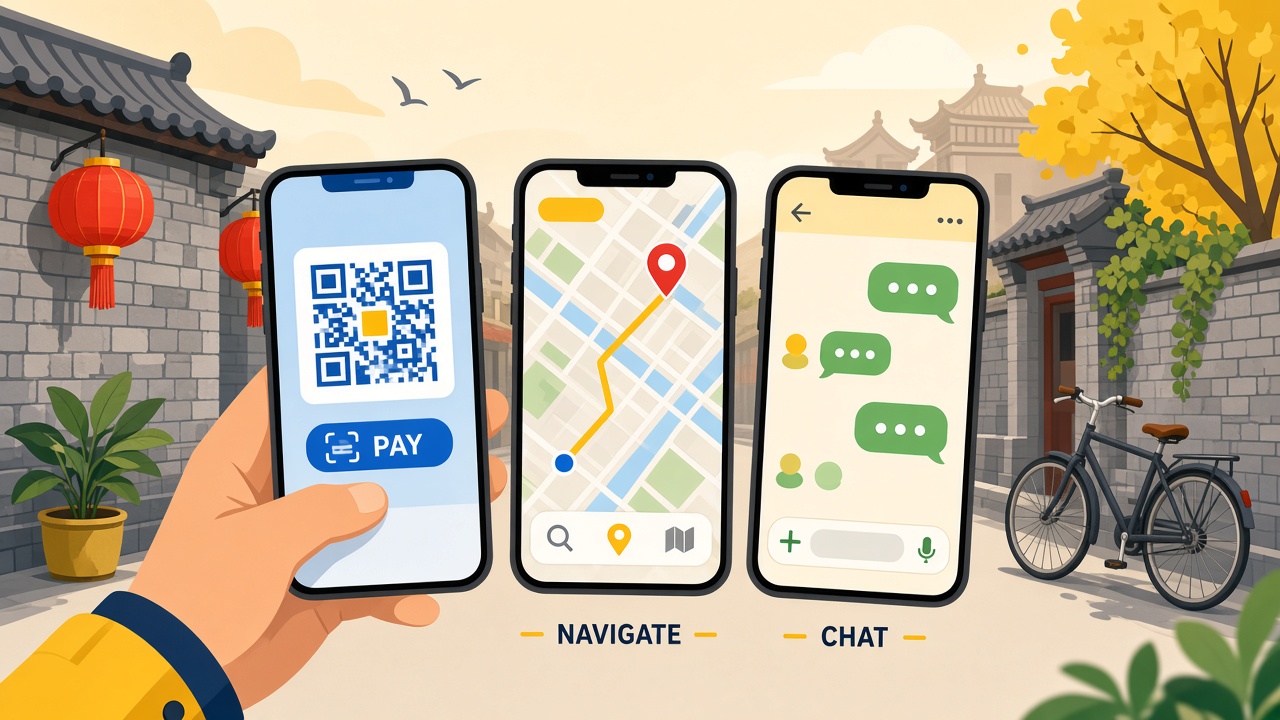
What apps do I need for China? The simple answer is three: Alipay to pay, Amap to get around and WeChat to talk to people. Download all three before you fly, link a bank card to Alipay, and you can handle almost every day-to-day task in Beijing or Shanghai.
Of course, you’ll find long lists of 10 or 15 “essential” China travel apps online. However, most first-time visitors don’t need them. In fact, too many apps just means more passwords, more verification codes and more stress at the airport.
So this is the simple version. Three apps, what each one does, and how to set them up in about 20 minutes.
Most Common Questions Our Guests Ask | Our Beijing
What are the 3 apps you need in China?
| App | What it’s for | Must-have? |
|---|---|---|
| Alipay | Paying for almost everything, plus metro codes and taxis | Yes |
| Amap (Gaode) | Maps, walking, metro and bus directions | Yes |
| Messaging hotels, guides and new friends | Yes |
That’s it. Google Maps, WhatsApp and most Western apps are blocked or unreliable in mainland China. As a result, these three local apps for China do the heavy lifting instead.
Why is Alipay the first of the apps you need in China?
China is close to cashless, and Alipay is the easiest way for visitors to pay. Street food stalls, cafés, museums and convenience stores all accept it. Many small vendors no longer keep change for cash.
The good news? You no longer need a Chinese bank account. Instead, you can link a foreign Visa, Mastercard and several other cards directly in the app. Alipay’s official international site explains which cards are supported.
How do I set up Alipay as a tourist?
- Download Alipay (the blue icon) from your app store at home.
- Sign up with your own phone number. A foreign number works fine.
- Add your bank card under “Bank Cards”.
- Verify your identity with your passport when asked.
- Test it with a small payment on your first day, such as a bottle of water.
Also, tell your bank you’re travelling. Otherwise, the first payment may be flagged as fraud. Small payments are usually free, although a fee can apply to larger amounts, so check the current terms in the app.
What else can Alipay do?
- Metro rides: scan a transport QR code at the gates in many cities.
- Taxis: book a Didi car inside Alipay, often in English.
- Translation: some mini-programs translate menus and signs.
For this reason, many travellers find they barely open any other China travel app.
Which map is best among China travel apps: Amap or Google Maps?
Amap is the most accurate map app in China, and it now has an English mode. Google Maps is blocked without a VPN. Even with one, its data in China is often outdated, and locations can be shifted by a few hundred metres.
Amap (高德地图, Gaode) shows real-time metro routes, bus times, walking directions and even which metro exit to use. In a city as big as Beijing, the right exit can save you a 15-minute walk. You can find it at amap.com or in your app store.
How do I switch Amap to English?
Open the app, tap your profile, go to Settings and choose English under language. Our full guide to the best map app for China walks through it step by step, with screenshots.
Our top Amap tip
Save your hotel’s Chinese name and address before you arrive. Then, if a taxi driver doesn’t speak English, simply show them the screen. It works every time.
Is WeChat one of the apps for China I really need?
Yes. Of all the apps for China, WeChat is how people message, call and share locations. Hotels, restaurants, tour guides and new friends will almost always ask, “Do you have WeChat?” rather than for your email or WhatsApp.
For example, when you join one of our experiences, your guide will often send the meeting point as a WeChat location pin. You tap it, and it opens straight in your map app. Download it from the official WeChat website or your app store.
Can I pay with WeChat too?
Yes, WeChat Pay also accepts many foreign cards. That said, we suggest Alipay as your main wallet and WeChat Pay as a backup. Having two ways to pay means one failed card won’t ruin your lunch.
Set up WeChat before you fly
New accounts sometimes need verification by an existing user. Therefore, sign up at home, when you have time and good Wi-Fi, rather than at the arrivals hall.
What apps do I need for China before I fly?
- Download your three apps for China (Alipay, Amap and WeChat) at home.
- Link your bank card to Alipay and verify your passport.
- Switch Amap to English and save your hotel address.
- Create your WeChat account and add a friend to test it.
- Sort out mobile data, such as an eSIM or roaming plan.
- Check entry rules on the National Immigration Administration website.
Want more detail on extras like Didi, Trip.com and Dianping? See our longer guide to essential China travel apps and our things to know before travelling to China.
Try your new China travel apps on a real Beijing adventure
The best way to get comfortable with the apps you need in China is to use them on day one. On The Hutong Experience, you’ll pay for snacks with Alipay and follow a WeChat pin to the meeting point. Prefer food? Our Street Food Discovery is full of tiny stalls where Alipay is king.
Meanwhile, adventurers can leave the city behind on the Huanghua Wild Great Wall Hike. We handle the logistics, so all you need is your phone and good shoes.
FAQs: what apps do I need for China?
What are the three essential apps for China?
Alipay for payments, Amap for maps and directions, and WeChat for messaging. Together, they cover paying, getting around and staying in touch.
Can foreigners use Alipay without a Chinese bank account?
Yes. You can link a foreign Visa or Mastercard and verify with your passport. Small payments are usually fee-free, while larger ones may carry a small charge.
Does Google Maps work in China?
Not reliably. It’s blocked without a VPN and often inaccurate. Amap, which has an English mode, is the better choice.
Do I need a VPN to use Alipay, Amap and WeChat?
No. All three are Chinese apps, so they work normally in China without a VPN.
Should I bring cash to China?
Bring a small amount as a backup, around a few hundred yuan. However, you’ll rarely use it, because mobile payment is accepted almost everywhere.
✨You’re reading a blog from Our Beijing ✨
We curate experiences for adventurous travellers who want something different.
—imagine riding through old Beijing hutongs, tasting our favourite street food snacks, or if you’re a top adventure seeker, hiking the wild, unrestored Great Wall.






Back to blog