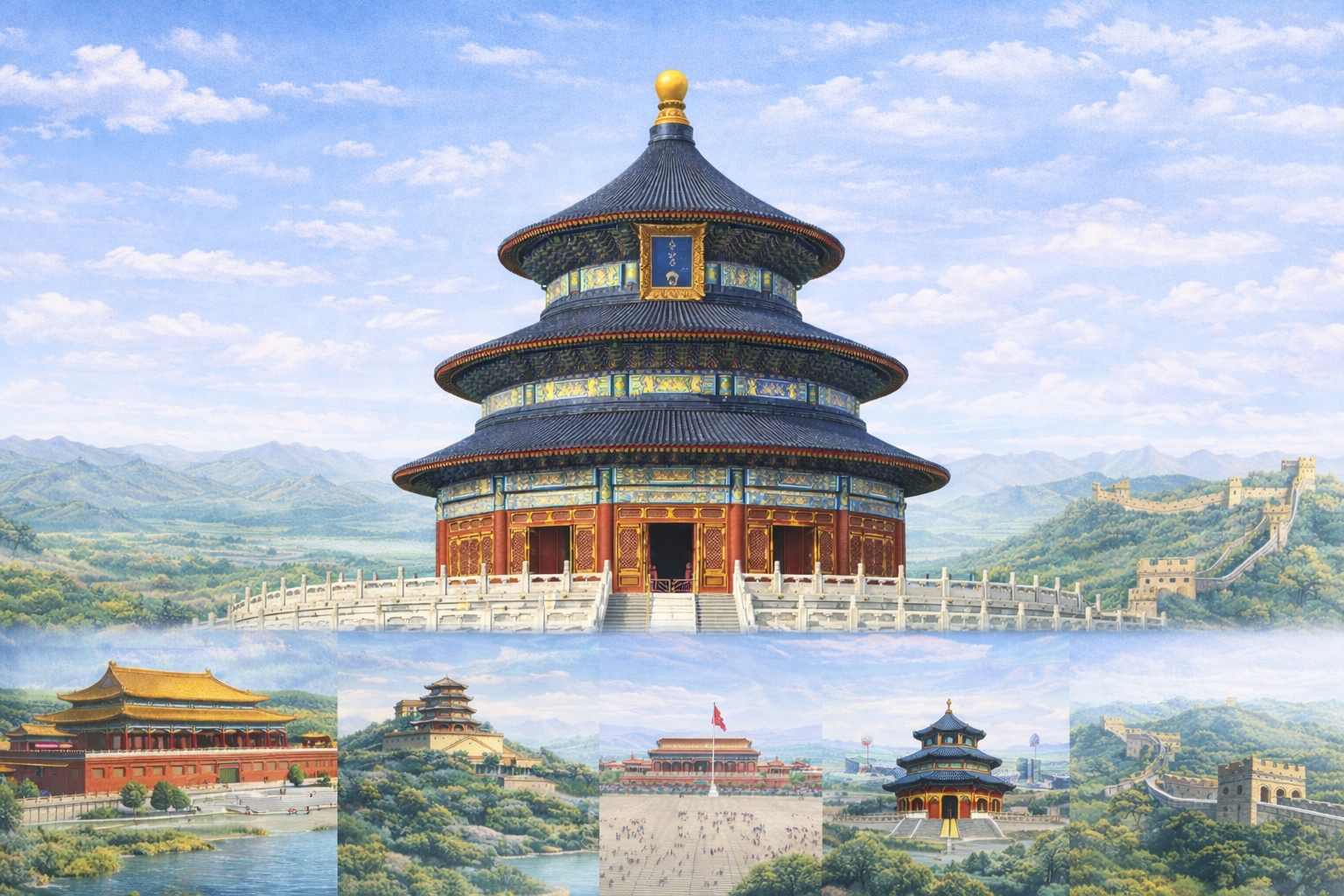
If there is one place that explains how ancient Beijing understood the universe, it’s the Temple of Heaven.
More than a park, this vast complex was the spiritual heart of imperial China—and today it’s one of the city’s most atmospheric places to explore.
The Temple of Heaven is located in southern Beijing, just outside the old city walls.
Its position is no accident. The site aligns directly with Beijing’s historic Central Axis, reinforcing its role as a bridge between heaven, earth, and imperial power. Here is a brief introduction on the official VisitBeijing website: https://r.visitbeijing.com.cn/attraction/2.
Construction began in 1420, during the Ming period, and the complex was later expanded and refined under the Qing emperors.
For nearly 500 years, emperors came here not to rule—but to pray.
The emperor was believed to be the “Son of Heaven.”
Each year, he performed highly ritualized ceremonies to:
These rituals were considered so sacred that ordinary citizens were forbidden from entering the grounds during ceremonies.
The most important rituals were held during the Winter Solstice, when the emperor:
If disasters followed a ceremony, it was believed the emperor had failed Heaven.
Today, the Temple of Heaven is both a UNESCO-listed heritage site and one of Beijing’s most beloved public parks.
You’ll see:
It’s one of the best places to see real daily life alongside imperial architecture.
Walk or ride along the southern section of Beijing’s Central Axis, linking ancient ritual space with imperial city planning.
🔗 Related Our Beijing guide:
Bike the Beijing Central Axis UNESCO Route Like a Local
This route reveals how Beijing was designed around symbolism, power, and balance—not just streets.
Prefer shopping and bargaining?
Just outside the east gate is Hongqiao Pearl Market, famous for:
🔗 Related Our Beijing guide:
Beijing Bargain Hunt: Hongqiao & Bairong Guide
Many visitors walk through the park without realizing what actually happened here.
Understanding the history transforms it from “a nice park” into one of the most meaningful sites in Beijing.
At Our Beijing, we don’t just show places—we help you understand how they connect.
Our Beijing is where your deeper journey starts.
👉 Walk it. Ride it. Experience it like a local.
👉 Imperial Beijing by bike & The Hutong Experience