December 22, 2025
Discover Beijing’s Stories: from Liulichang to Hufangqiao
Ready to discover Beijing’s stories with your own feet? In the blog Liulichang Street: A Local Experience in Beijing, we explored the cultural trove of Liulichang. If your feet are still willing, let’s continue the adventure. We’ll wander from the scholarly streets into the living heart of old Beijing, following a path where tea, tigers, and timeless stories converge.
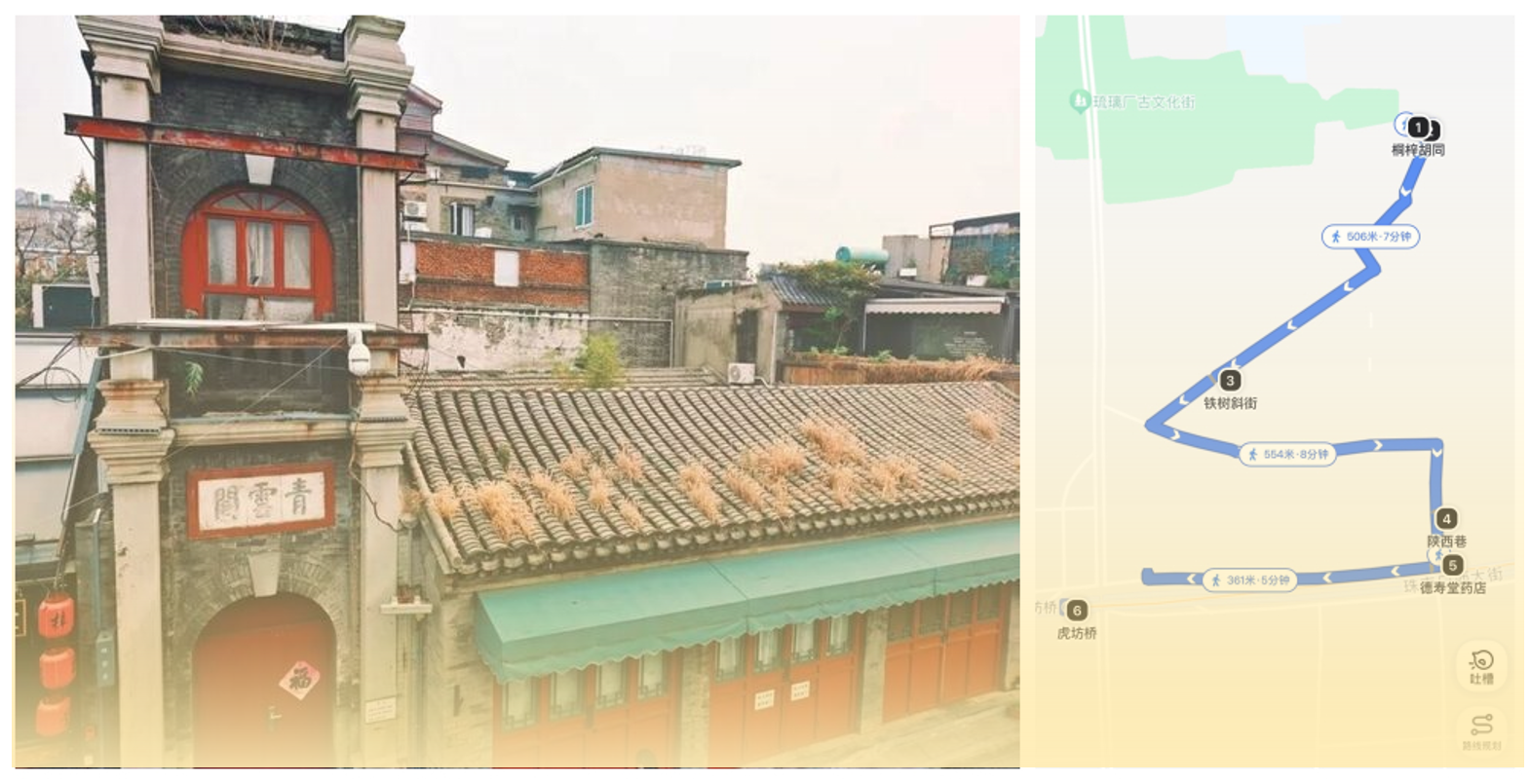
Here is the full route for your walk:
Start at Liulichang. From its east end, turn into Tongzi Hutong (桐梓胡同). Then, walk to Yangmeizhu Xie Street (杨梅竹斜街). Continue north from there to Tieshu Xie Street (铁树斜街), and then into Shanxi Lane (陕西巷). Finally, head east to visit Deshou Hall (德寿堂) on Zhushikou West Street, which brings you to the Hufangqiao (虎坊桥) area and your journey’s end.
Use AMap or Baidu Map to navigate.
🪷 Part 1: From Quiet Lanes to Vintage Shops
First, leave Liulichang and enter Tongzi Hutong. The hutong quiets down here, making it a perfect spot to pause before you continue. Walk south until you reach the junction with Yingtao Xie Street (樱桃斜街), and you’ll find the serene Cheng Xiang Schoolhouse (澄象学堂) tucked away. Here, it offers a perfect pit stop. More than a teahouse, it’s a workshop where you can learn the quiet art of making traditional lanterns—a moment of creation in the middle of your exploration.
You will then emerge onto Yangmeizhu Xie Street. This lane is a blend of old and new. So, be sure to peek into these unique spots.
- Beijing Postcards (No. 97): This tiny shop is easy to miss, but it’s a real time capsule. It feels less like a store and more like a quiet gallery. You can browse old photos, maps, and prints here. It’s like a private collection open just for you.
- Soloist Coffee Co. (No. 39): This is an established café, and it offers a full experience. The coffee is on the pricier side, but the vintage décor is great. The small balcony overlooks the hutong, so the view is worth the price.
- Qiankun Space (No. 26): The name means “universe,” and it really fits. This shop is vibrant and packed with colorful crafts. The owner is passionate, so she brings every item to life with a story. This creates a wonderfully warm atmosphere in this culture walk.
Next, look up at Qingyun Pavilion (青云阁). This elegant “sedan building” was once the city’s top luxury mall—a place where Lu Xun (鲁迅) dined, books were sold, and the first game of billiards in Beijing was played. Its grandeur may be faded, but its architecture still speaks of past glamour. This area lets you touch the soul of old Beijing.
🐅 Part 2: History, Tigers, and a Clever Train
Now, the walk becomes a real culture adventure. Turn onto Tieshu Xie Street. The mood deepens here, and this lane leads you into Shanxi Lane. This is part of the historic “Eight Great Lanes” district.
The area has a modern reputation, but it was once very different. It was the bustling heart of Beijing’s opera scene. The famed Sixi Ban opera troupe lived here. Then, it was also home to independent women like Sai Jinhua and Xiao Fengxian. Their lives were so legendary, so they became stories themselves.
The real showstopper here is Deshou Hall (德寿堂). This isn’t just an old pharmacy. Its founder was a marketing genius. In the 1930s, he installed a small model train. It chugged out of the building’s façade on the hour, and a giant clock went with it. This was a sensational spectacle, so it drew massive crowds.
The train is lost now, but the clock and the green-tiled façade remain. They mark its journey from a crowd-puller to a protected relic. It’s open daily (8:30 AM – 8:00 PM), and it makes a fascinating final chapter to your walk.
Afterward, walk to Hufangqiao (虎坊桥) Station to finish your journey, or stop for a traditional Beijing hotpot before catching the train.
You may wonder why we haven’t mentioned tigers yet. Well, there’s a reason for that. Why is the final stop called “Tiger Bridge” (虎坊桥)? The name is a clue: old Beijing had forested mountains where real tigers once lived. People built temples to appease them, which is why we still have names like “Tiger Temple Lane” today.
The name “Hufang Bridge” is even more direct. Because during the Ming Dynasty, this area housed the royal tiger enclosures. A bridge was built east of the pens, so it was literally named “Tiger Room Bridge.”
✨ The Takeaway
This walk is more than a simple stroll. It’s a way to see the city’s layers, from craft shops and opera lanes to a pharmacy with a train. So, take this culture walk, and let the old stones tell you their tales. You’ll find that the best way to discover Beijing’s stories is simply to start walking.
Love exploring Beijing’s hidden layers?
Today’s walk is just the beginning.
👉 Dive deeper with our guided Hutong Experiences for more local stories and secret courtyards.
👉 Crave adventure? Join our Wild Great Wall Hikes to trek wild, ancient sections with epic views.
Your next Beijing adventure awaits. Choose your path with Our Beijing.
Back to blog